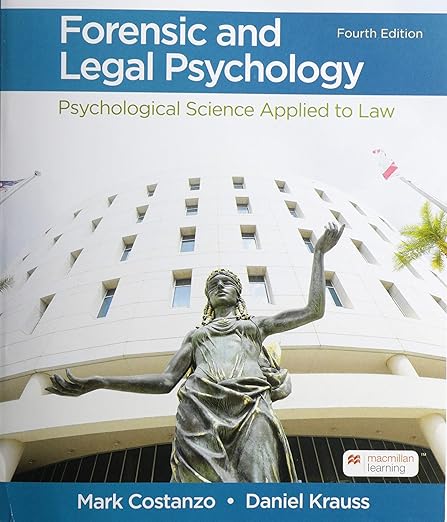
Available in print and e-book formats, Mark Costanzo and Daniel Krauss’s text show students how psychological science can be used to reduce crime, improve legal decision making, and promote justice. Fully integrated discussions of real cases and trials, along with other examples of the legal system in action, show how research and theory can deepen our understanding of suspects, criminals, police, victims, lawyers, witnesses, judges, and jurors.


Fundamentals of Corporate Finance 2e reflects the reality that Finance as an intellectual discipline continues to be challenged by the experiences and events of market activity. Following the global financial crisis (GFC), mangers have embarked on even more uncertain times. Thus, although the teaching of finance may have remained robust as a framework of conceptual thought, it is imperative that students come to realise that "finance is not physics", by which we mean that even a concept as foundational to financial management as the capital asset pricing model (CAPM) should not be interpreted as a literal truth. This leads to a consideration of managing risk and risk management approaches as having behavioural aspects that are the outcomes of a manager’s or the firm’s accumulated experience. They cannot always be reduced to the simple directives of a quantitative algorithm.


GARDNER'S ART THROUGH THE AGES: THE WESTERN PERSPECTIVE, VOLUME I, gives you the tools to master your course material. A unique scale feature will help you better visualize the actual size of the artworks shown in the book. Within each chapter, the "Framing the Era" overviews, timeline, extended captions, and the chapter summary section titled "The Big Picture" will help you review for exams. In addition, MindTap for this 15th edition of GARDNER'S ART THROUGH THE AGES provides an interactive digital experience for exploration, study, and development of critical-thinking skills. It includes an interactive eBook with note taking capability, zoomable versions of images included within the text, over 100 videos, audio resources, image flashcards, a Guide to Studying, quizzes and critical-thinking questions, and much more.

Written with a clear, straightforward writing style and packed with step-by-step projects for direct, hands-on learning, Guide to UNIX Using Linux, 4E is the perfect resource for learning UNIX and Linux from the ground up. Through the use of practical examples, end-of-chapter reviews, and interactive exercises, novice users are transformed into confident UNIX/Linux users who can employ utilities, master files, manage and query data, create scripts, access a network or the Internet, and navigate popular user interfaces and software. The updated 4th edition incorporates coverage of the latest versions of UNIX and Linux, including new versions of Red Hat, Fedora, SUSE, and Ubuntu Linux. A new chapter has also been added to cover basic networking utilities, and several other chapters have been expanded to include additional information on the KDE and GNOME desktops, as well as coverage of the popular OpenOffice.org office suite. With a strong focus on universal UNIX and Linux commands that are transferable to all versions of Linux, this book is a "must-have" for anyone seeking to develop their knowledge of these systems.
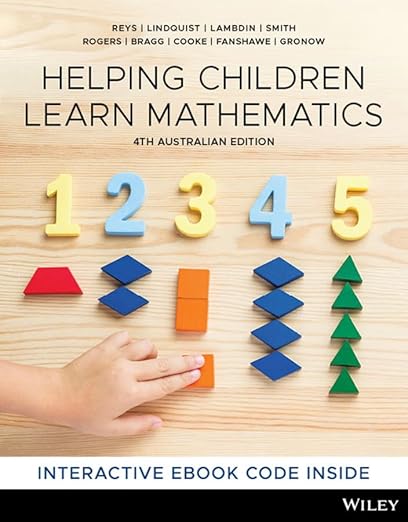
The ninth edition of this best-selling elementary mathematics methods textbook continues its rich history with a new contemporary design. Helping Children Learn Mathematics, Ninth Edition has been updated to reflect current recommendations, readings, children's books, research findings, and practices while maintaining the characteristics and features that have made it a popular choice for instructors. This is an invaluable text for students who are being introduced to teaching elementary mathematics. In addition, its depth also makes it appropriate for teachers to use as they continue to learn about teaching mathematics.

This is the long-awaited second edition of this widely-referenced work on the substantive law principles of investment treaty arbitration. It forms a detailed critical review of the substantive principles of international law applied by investment arbitration tribunals, and a clear and comprehensive description of the present state of the law. The first edition met with immediate success as a result of the authors' achievement in describing and analyzing the volume of law created, applied and analyzed by tribunals. The second edition is fully updated to take account of the arbitration awards rendered in the period since 2007. Written by an internationally recognized author team, it is now the most comprehensive and up to date work in its field and no practitioner or academic can afford to be without it.
Key areas of coverage include: the instruments under which investment disputes arise; the legal basis of treaty arbitration; dispute resolution and parallel proceedings; who is a foreign investor, including nationality issues and foreign control; what is an investment; investors' substantive rights, including fair and equitable treatment; expropriation; compensation and remedies.
Arbitration of overseas investment disputes is one of the fastest growing areas of international dispute resolution. The exponential growth of international investment in recent years has led to the signature of over two thousand Bilateral Investment Treaties (BITs) between foreign states, in addition to a wealth of multilateral treaties and other forms of concession agreements. The legal principles that have developed in this area are subject to intense debate, and are still in a state of flux. While tribunals routinely state that they are applying principles of public international law to determine disputes, many of the principles applied have only been developed recently in the context of investment treaty arbitrations, and tribunals are often guided more by the approaches taken by other tribunals, than by pre-existing doctrines of public international law. International Investment Arbitration:Substantive Principles is an important contribution to the collection and codification of the current state of practice in this field.

Discover how empirical researchers today actually think about and apply econometric methods with the practical, professional approach in Wooldridge�s INTRODUCTORY ECONOMETRICS: A MODERN APPROACH, 5E. Unlike traditional books on the subject, INTRODUCTORY ECONOMETRICS� unique presentation demonstrates how econometrics has moved beyond just a set of abstract tools to become a genuinely useful tool for answering questions in business, policy evaluation, and forecasting environments. Organized around the type of data being analyzed, the book uses a systematic approach that only introduces assumptions as they are needed, which makes the material easier to understand and ultimately leads to better econometric practices. Packed with timely, relevant applications, the text emphasizes incorporates close to 100 intriguing data sets in six formats and offers updates that reflect the latest emerging developments in the field.